Get ready for an immersive, studio-style workshop where theory instantly becomes practice! Whether you bring your own live urban project to supercharge or jump into our custom-crafted demo masterplan, you’ll work side-by-side with BIG’s top talent in an interactive, real-world design studio environment.
- Step 1: Unpack the BIG Storyboard
Dive into elite urban design principles and real BIG case studies. Learn to "read" massive masterplans, breaking down complex site narratives into clear, multi-scalar frameworks. - Step 2: Sculpt the 3D Volumetric Gesture
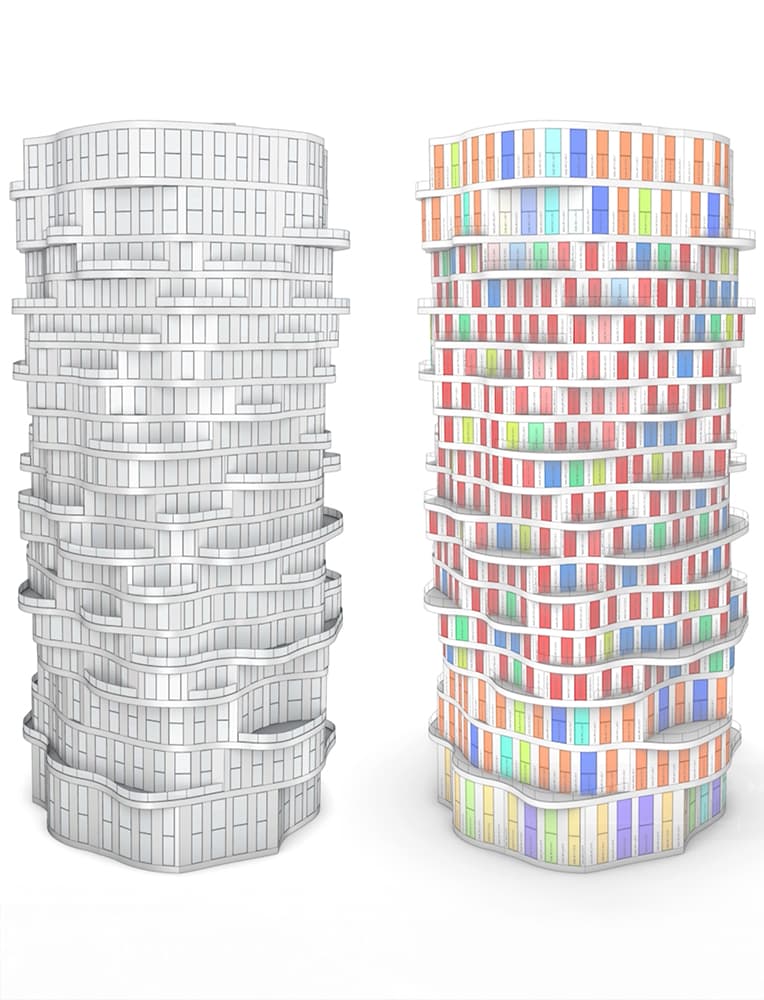
Take your flat 2D planning frameworks and extract them into stunning, step-by-step 3D axonometric sequences inside Rhino. - Step 3: Build the High-Impact Pitch Deck
Transform raw linework into publication-ready visual assets. Annotate, format, and assemble a crisp, persuasive pitch deck in Illustrator and InDesign that commands attention. - Step 4: Unleash the AI Animation Engine
Watch static geometry come alive! Feed your 3D keyframes into Krea.AI or Gemini to auto-generate fluid video transitions between steps, then stitch it all together in Premiere Pro for a showstopping finish.
Program:
Day 1: Frameworks, Storyboards & Camera Angles
- Unpack core urban design principles, multi-scalar case studies, and the art of architectural storytelling directly from Bjarke Ingels Group.
- Set up your project reading framework using the studio demo masterplan or your own urban design site.
- Extract and break down urban layers step-by-step, moving seamlessly from macro grids and superplots down to individual parcel plots and building massing.
- Storyboard your concept’s unique narrative logic and configure precision cameras in Rhino to capture every crucial angle.
Day 2: 3D Volumetrics, Annotation & AI Motion
- Build a powerful 3D axonometric sequence in Rhino that translates your Day 1 plan layers into clear, volumetric design moves.
- Develop publication-ready presentation boards by cleaning, styling, and annotating vector linework in Illustrator and InDesign.
- Generate smooth AI video transitions between your static 3D steps using Krea.AI and Google Gemini.
- Stitch, edit, and export your final animated concept reel—ready to dominate client pitches, competition entries, and portfolio reviews.
Who Is This Workshop For?
This workshop is tailored for architecture and urban design students, practicing masterplanners, and ambitious portfolio builders who want to translate complex spatial ideas into clear, compelling narratives. Whether you are aiming to refine your university thesis, elevate competition entries at your firm, or explore practical ways to integrate generative AI into your Rhino workflow, this live studio offers a structured path forward.