This workshop shifts AI-assisted architectural design from chaotic prompting to strategic execution by converting spatial briefs into explicit, parametric rule sets before any agent touches the project. Operating on a strict "read and plan first, write second" protocol, it requires every spatial connection and workflow strategy to be verified before granting write access to tools, serving simultaneously as a core safety habit and a debugging framework.
The methodology prioritizes context engineering over prompt phrasing, recognizing that curated reference data, managed token budgets, and prompt caching dictate generation quality far more than stylistic language. Under this division of labor, the AI acts strictly as the draftsman managing tedious, repetitive, and automatable tasks, while the architect steps into the role of editor defining intent and auditing spatial outputs. To ensure rigorous standards, results are continuously validated through dual-model benchmarking, subjecting identical briefs and Model Context Protocol (MCP) setups to two separate models judged against a single custom rubric.
Scope:
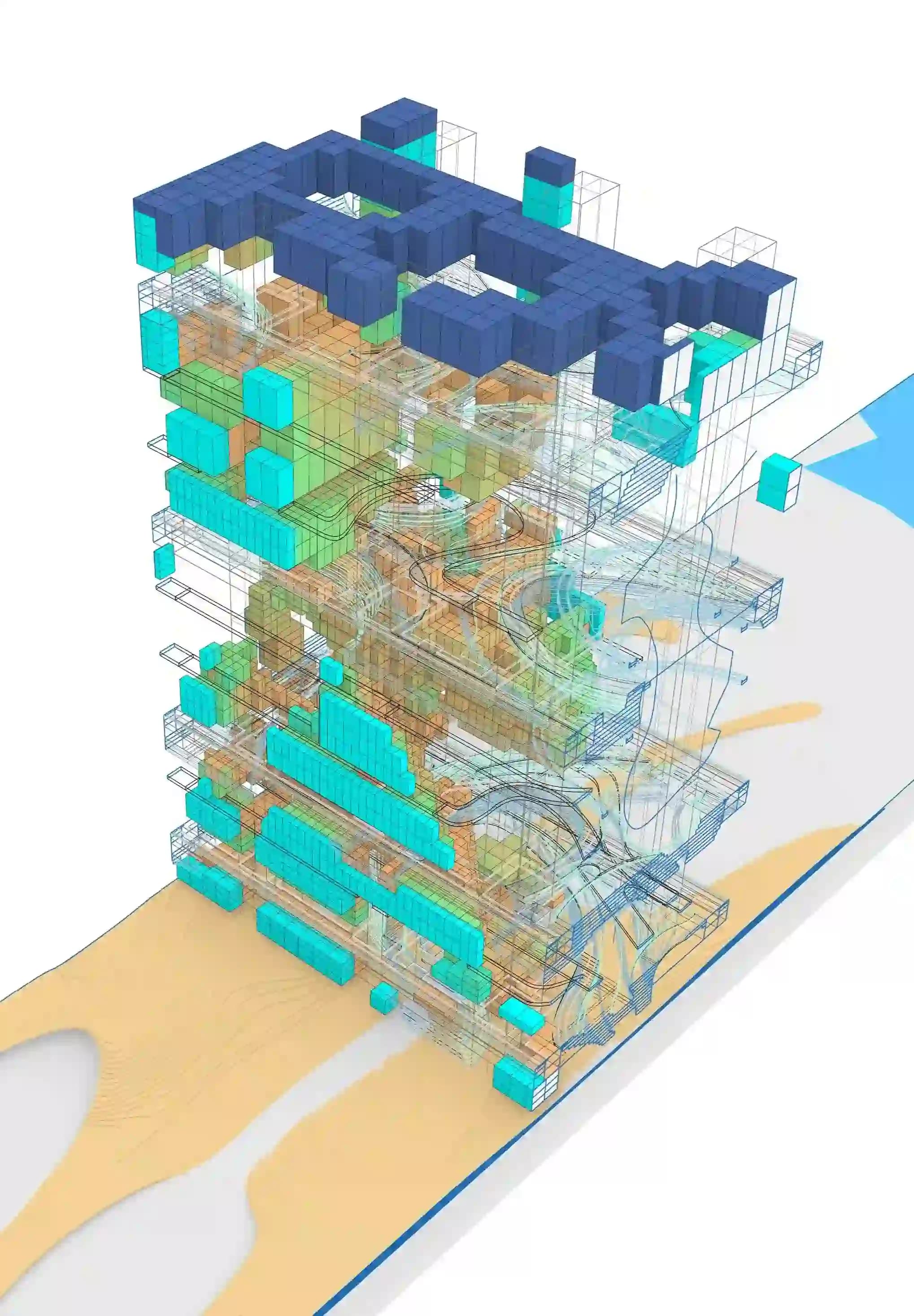
This workshop focuses on a mid-rise mixed-use housing block on a constrained plot, where spatial logic relies on legible, testable rules rather than subjective intuition. Capitalizing on the AI's strength in consistent rule execution, participants translate constraints such as setbacks, unit mixes, cores, heights, and façade modules into deterministic scripts.
Two technical tracks demonstrate rule enforcement across design phases. The Rhino track targets massing logic, stacking rules, variant generation, and group definitions for early-stage geometry. The Revit track focuses on model interrogation, family parameters, clash detection, and data scheduling for documentation. Throughout both, the AI serves as draftsman while the architect retains strategic editorial control.
Program:
- Setup: Installing Rhino MCP and Revit MCP, client configuration
- The State of the Race: Frontier models, agentic versus generative AI, MCP as the AEC connective layer
- Methodology, Tokens, and Cache: Mapping the approach, context packs, token budgets, prompt caching
- Break Modeling with Rhino MCP: Toolsets, rule-checked massing, variants, and group definitions
- Break Modeling with Revit MCP: Toolsets, live model auditing, and parametric family modeling
- Dual-Model Benchmarking & Practice Roadmap: Model evaluation, cost comparison, and workflow implementation