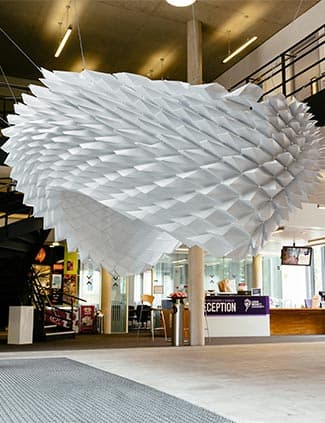
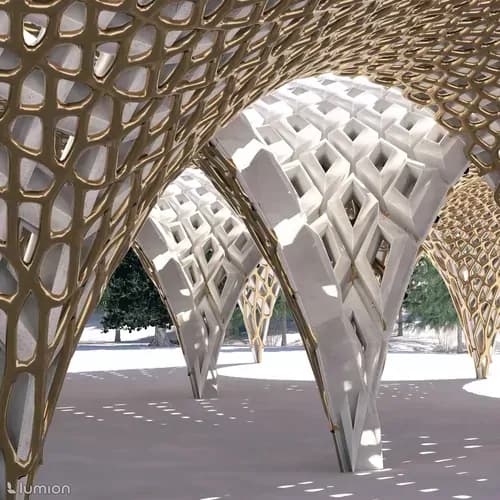
Participants will develop a new modular architectural system created specifically for the workshop. It will draw on principles from Mamou-Mani’s architectural projects and Fab.Pub’s circular-material research without reproducing client work or disclosing proprietary files.
The project will progress through concept development, parametric modelling, material constraints, modularisation, robotic toolpathing, assembly and future reuse.
The material focus will be large-scale 3D printing with reclaimed or recycled compounds. Available material volume, print bed size, layer height, minimum curvature, overhang analysis, connections, print direction, and disassembly requirements will inform the design and fabrication strategy.
A 45-minute live revision session will take place two weeks after the workshop to check your progress and answer any remaining questions.
Students will:
- Interpret an architectural brief and define its regenerative-material objectives.
- Use AI-assisted exploration to test design directions and visualise the system in context.
- Develop an adaptable architectural system in Rhino and Grasshopper.
- Translate material and fabrication constraints into geometry, modules and connections.
- Prepare a selected component for robotic fabrication and large-scale 3D printing.
- Reassemble the components and evaluate disassembly, reprocessing and future reuse.
- Demonstrate RunChat as a bridge between precise parametric geometry and rapid visual iteration.
Program
Day 1: Brief to Parametric System
Block 1 - From Brief to System:
- Introduction to the single canopy or pavilion brief
- Review of relevant built precedents
- Definition of regenerative-material objectives
- Role of AI in transitioning from narrative intent to a controlled design system
Block 2 - Building the Parametric System - Led by Fun Yuen:
- Live build of the workshop project in Grasshopper
- Parametric control over module dimensions, density, and curvature
- Integration of connections, material limits, and fabrication constraints
Day 2: Robotic Toolpathing & Circular Workflow
Block 3 - From Geometry to Robotic Toolpath - Led by Clinton Mendonca:
- Transitioning Grasshopper geometry into robotic fabrication
- Setting tolerances, print orientation, and componentisation
- Defining bead and layer logic, robotic toolpaths, and G-code
- Conducting production checks for reclaimed printing compounds
Block 4 - Completing the Circular Workflow:
- Reassembling components into the complete canopy or pavilion system
- Testing assembly and disassembly logic
- Evaluating reprocessing and reprinting strategies
- Using AI-assisted visualization to present the design in context










 Walter Patrick SmithAdvanced Grasshopper 1.0