Skill up, Design Better 🚀 Get 35% OFF all previous workshops!

February 2026 Workshops Bundle

Access all PAACADEMY’s February workshops in one bundle and master advanced AI, computational design, and robotic fabrication workflows.

5 Courses
English
Unlimited Access
Approx. 00:00:00
Certificate — Learn
€400.00
€240.00
Best deal for you!
February 2026 is about systems, intelligence, and execution. This bundle brings together five advanced workshops that move fluidly between data-driven thinking, adaptive AI methodologies, geometric rigor, and physical making.

The February bundle focuses on how architects and designers structure complexity: reading landscapes through data, building second brains for design intelligence, crafting cinematic narratives with AI, generating high-performance geometry through advanced parametric logic, and translating irregular real-world forms into robotic fabrication workflows.

Rather than treating AI, computation, and fabrication as isolated tools, these workshops emphasize connected pipelines where analysis, concept formation, geometry, visualization, and execution inform one another.

All workshops include live interactive sessions, Q&A with instructors, certificates of completion, and lifetime access to the recordings.
This Bundle Includes 
  1. Algorithmic Urban Design in Grasshopper: Data-Driven Site Analysis & Massing
  2. Synthetic Architecture: AI-Powered Adaptive Workflows
  3. Cinematic Architecture: AI-Powered Design Workflows
  4. Advanced Grasshopper 3.0: NURBS, Mesh & Volumetric Design Systems
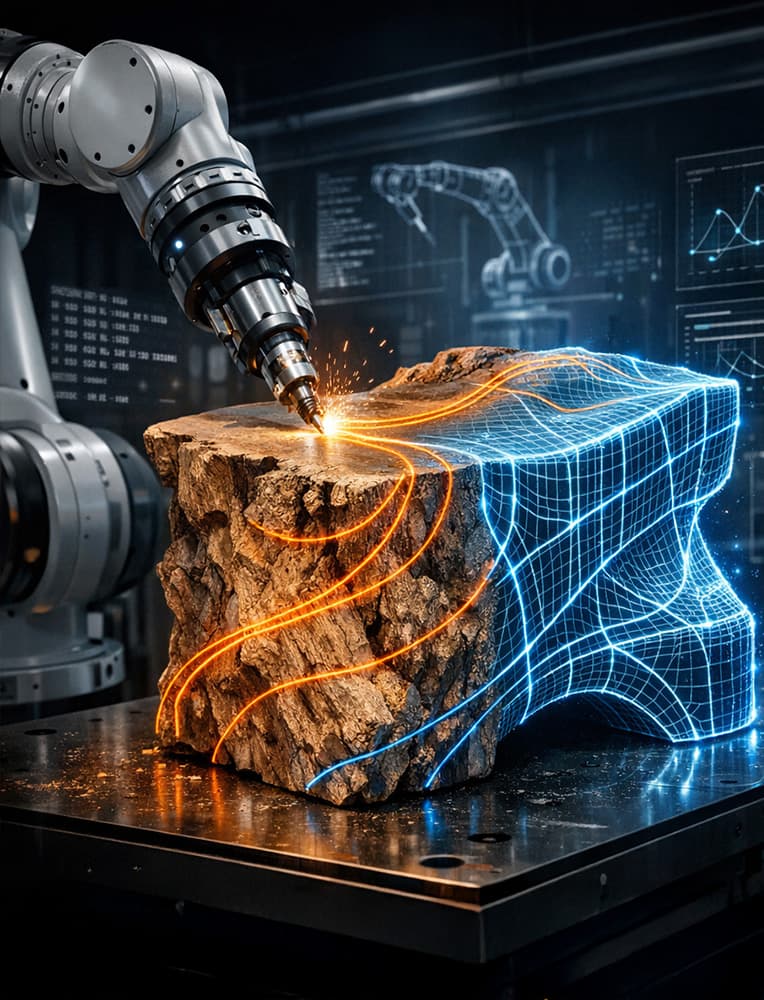
  5. Robotic Fabrication for Irregular Geometry 
What You Will Learn
Algorithmic Urban Design in Grasshopper: Data-Driven Site Analysis & Massing 
  1. Apply algorithmic thinking to early-stage urban design
  2. Analyze terrain using sunlight, slope, vegetation, and visibility data
  3. Create custom site analysis methods from scratch in Grasshopper
  4. Translate environmental data into generative urban massing
  5. Develop parametric models capable of producing multiple urban scenarios
  6. Structure and optimize complex Grasshopper definitions
 Synthetic Architecture: AI-Powered Adaptive Workflows 
  1. Build Second Brains to organize references, ideas, and design intelligence
  2. Read context critically by understanding what is faulty, misplaced, or unresolved
  3. Develop adaptive, modular AI workflows beyond prompt-based generation
  4. Combine AI tools into controlled, meaningful architectural illustrations
  5. Validate AI-driven concepts using environmental simulations and Light BIM
  6. Construct architectural narratives through storytelling and visual surgery
Cinematic Architecture: AI-Powered Design Workflows
  1. Master advanced prompting techniques in MidJourney for interiors and exteriors
  2. Edit and refine architectural images using AI-based tools and references
  3. Maintain visual consistency across multiple AI-generated views
  4. Generate cinematic architectural videos using keyframes and storytelling logic
  5. Animate transitions, morphing, and spatial sequences for project presentations
  6. Build compelling AI-driven visual narratives for architectural communication
Advanced Grasshopper 3.0: NURBS, Mesh & Volumetric Design Systems
  1. Work fluently across NURBS, mesh, and volumetric modeling paradigms
  2. Choose geometric strategies based on design intent and performance goals
  3. Build hybrid Grasshopper workflows that combine multiple geometry types
  4. Generate complex forms using procedural and rule-based systems
  5. Use advanced plugins for implicit, voxel-based, and lattice modeling
  6. Convert complex geometry into fabrication-ready outputs
Robotic Fabrication for Irregular Geometry 
  1. Develop scan-to-robot workflows using computer vision and digital twins
  2. Generate surface-aware toolpaths for irregular and noisy geometries
  3. Understand robot kinematics and validate reachability and safety
  4. Simulate robotic fabrication processes using the Robots plugin
  5. Export machine-readable code for robotic execution
  6. Bridge real-world physical objects with adaptive robotic fabrication logic
Why Join the February Bundle?
  1. Learn live from instructors working at the forefront of AI, computation, and robotics
  2. Gain hands-on experience with Grasshopper, Rhino, Ladybug, MidJourney, ComfyUI-style workflows, Robots, and advanced AI tools
  3. Explore workflows that connect urban design, architecture, visualization, geometry, and fabrication
  4. Participate in interactive sessions with direct instructor feedback
  5. Receive official PAACADEMY certificates for all five workshops
  6. Enjoy lifetime access to all workshop recordings
  7. Save up to 40% compared to enrolling in the workshops individually

Pa Course
Days
Hrs
Min
Pa Course
Days
Hrs
Min
Pa Course
Days
Hrs
Min
Pa Course
Days
Hrs
Min
Pa Course
Days
Hrs
Min

Meet Your Instructors

0 Followers

0 Following

Biography
Ognjen Graovac is an architect and computational designer from Belgrade who loves blending design, technology, and creative problem-solving. He completed both his Bachelor’s and Master’s degrees at the Faculty of Architecture in Belgrade, where he first got into parametric and computational design. That curiosity quickly pushed him toward object-oriented programming and creating digital tools and workflows to expand architects’ ability to design complex and precise shapes.A year later, Ognjen founded Algorithmic Architecture, a small studio focused on solving geometric challenges in complex architectural forms and automating the creation of precise, large-scale 3D models for the building industry. Through his work, he has contributed to both small and large projects, including major developments such as Madison Square Garden in Las Vegas. Ognjen is also an active member of the open-source community. He develops free Grasshopper plugins such as 3D Graphic Statics and Spider 3D. The 3D Graphic Statics plugin alone includes over 100 components and has been downloaded more than 11,000 times worldwide. He has also won several awards in architectural competitions, including a first-place prize for a pedestrian bridge over the Danube River in Novi Sad.

2 Followers

0 Following

Biography
Synthetic Architecture (Ozan Ertuğ & Pınar Ongun) Founded in 2023 by Pınar Ongun and Ozan Ertuğ, Synthetic Architecture is a research and development studio that merges over 20 years of architectural experience—spanning design, education, theory, and application—with artificial intelligence.Ozan Ertuğ (YTÜ, 2006) focuses on computational design, smart simulation, and interactive spatial strategies. His passion in the field of architecture has been to foresee what would happen in the near and far future, to analyze and recognize what has been done before, and to realize the present as a result of this process. He adopted a hybrid design process in which hand sketches, handicraft prototyping, and computational design techniques are combined. In these processes, he feels passionate about dealing with ecology and sustainability to respond to dynamic living standards and climate realities in design.

1 Followers

0 Following

Biography
Alina Holovatiuk is a Ukrainian architect, AI enthusiast, blogger, and the founder of the musical startup InTempo in Kyiv, Ukraine, currently working as an architectural designer & AI consultant at the Kyiv-based firm ARDIS. She is the author of the international social experiment "Architecture & Happiness" for her master’s thesis. She holds a Master of Architecture degree from Kyiv National University of Construction and Architecture, where her diploma project, “Memes in Architecture,” explored internet memes (objects or symbols that encode specific information) in real-life public spaces. Alina is a winner/finalist of more than 29 international and national architecture/design/fine art contests. Her AI works were showcased in Seoul, Tokyo, San-Fransisco, and Detroit, and she is consulting architectural bureaus on AI applications.

13 Followers

0 Following

Biography
Amir Hossein is a Ph.D. student in Architecture at Pennsylvania State University, specializing in Design Computing. His research focuses on computational design methods and digital fabrication, particularly in the area of additive manufacturing of concrete structures. This work aims to enhance automation in construction and promote sustainable architectural practices, reflecting his commitment to innovation in the field. Before pursuing his doctoral studies at Penn State, Amir gained six years of experience as an architectural and computational designer in Iran. During this time, he worked on various projects involving design optimization, complex 3D modeling, and computational workflows. This professional background has provided him with a strong understanding of how parametric design tools like Grasshopper can be effectively applied in real-world architectural practices. In addition to his research and practical experience, Amir has been teaching computational design software, including Grasshopper and its ecosystem of plugins, for several years. Through workshops and educational initiatives, he aims to share his knowledge and expertise, helping participants unlock the full potential of Grasshopper in their design practices and research projects.

1 Followers

0 Following

Biography
Zvonko is an architect turned engineer and digital fabricator. He is currently addressing the challenge of integrating data science and machine learning into design and fabrication processes. He is working on his company, Pixolid UG, which operates in these fields, in Berlin. Zvonko has also been active in academia, working as a researcher and lecturer at various universities in Berlin and the surrounding area, including TU Berlin, BTU Cottbus, and IU Berlin, in the fields of digital fabrication, robotics, and computational/generative design. His work focuses on bridging the gap between digital models and physical realities by training models to enhance robot-to-robot and human-to-robot collaboration. In this workshop, he will share his experience of translating real-world objects from photographs and demonstrate how computer vision and adaptive toolpaths can transform fabrication and design workflows.
No reviews yet.

No comments found.