.webp&w=3840&q=75)
Article
The Dawn of a Digital Era in AEC
In the Architecture, Engineering, and Construction (AEC) industry, the way we design and build has undergone a seismic shift, propelled by the rise of digital tools that blend creativity with exactitude. At the forefront of this transformation is Building Information Modeling (BIM), a methodology that transcends traditional blueprints, offering a multidimensional lens into a project’s lifecycle. Within this framework lies the Level of Development (LOD)—a concept that defines how detailed, reliable, and purposeful a BIM model becomes as it evolves from a rough idea to a fully realized structure.
.webp)
LOD is more than a technical standard; it’s a roadmap for collaboration, a language that ensures architects, engineers, contractors, and owners are aligned at every step. It’s about trust—knowing when a model is a sketch to dream on or a blueprint to build from. As projects grow in complexity—think towering skyscrapers or meticulously restored heritage sites—LOD provides the clarity needed to navigate the chaos, turning visions into realities with precision.
.webp)
This article delves into the heart of LOD in BIM, exploring its foundations, its practical applications through real-world examples, and the tools that power it in the AEC industry. From conceptual massing to fabrication-ready details, LOD is the thread that ties BIM’s potential to tangible outcomes, reshaping how we approach the built environment.
.webp)
Understanding BIM: The Foundation of LOD
Before diving into LOD, it’s worth unpacking BIM itself. Building Information Modeling is a process that creates and manages digital representations of physical and functional characteristics of a building. Unlike 2D drawings, BIM integrates geometry with data—think dimensions, materials, costs, and even timelines—into a single, intelligent model. This “information” aspect is what sets BIM apart, enabling stakeholders to simulate, analyze, and refine a project before a single brick is laid.
BIM’s power lies in its collaborative nature. Architects might use it to design a façade, engineers to size a beam, and contractors to sequence construction—all within the same model. It’s a living document, evolving from design to construction to operation. The global adoption of BIM has surged, with firms like Foster + Partners and Skanska leveraging it for iconic projects like the Gherkin in London or the renovation of New York’s Penn Station. LOD, in turn, is the mechanism that governs this evolution, ensuring the model’s growth aligns with project needs.
Decoding LOD: The Backbone of BIM
.webp)
- LOD, or Level of Development, is the metric that tracks a BIM model’s maturity. Defined by the American Institute of Architects (AIA) and refined by BIMForum’s LOD Specification, it spans six levels, each a milestone in a project’s journey:
- LOD 100: Conceptual placeholders—rough masses or blocks, offering approximate shapes and positions for early planning.
- LOD 200: Approximate geometry emerges, with sizes, locations, and orientations sufficient for cost estimates and spatial analysis.
- LOD 300: Precision kicks in—exact dimensions, materials, and connections ready for construction documentation.
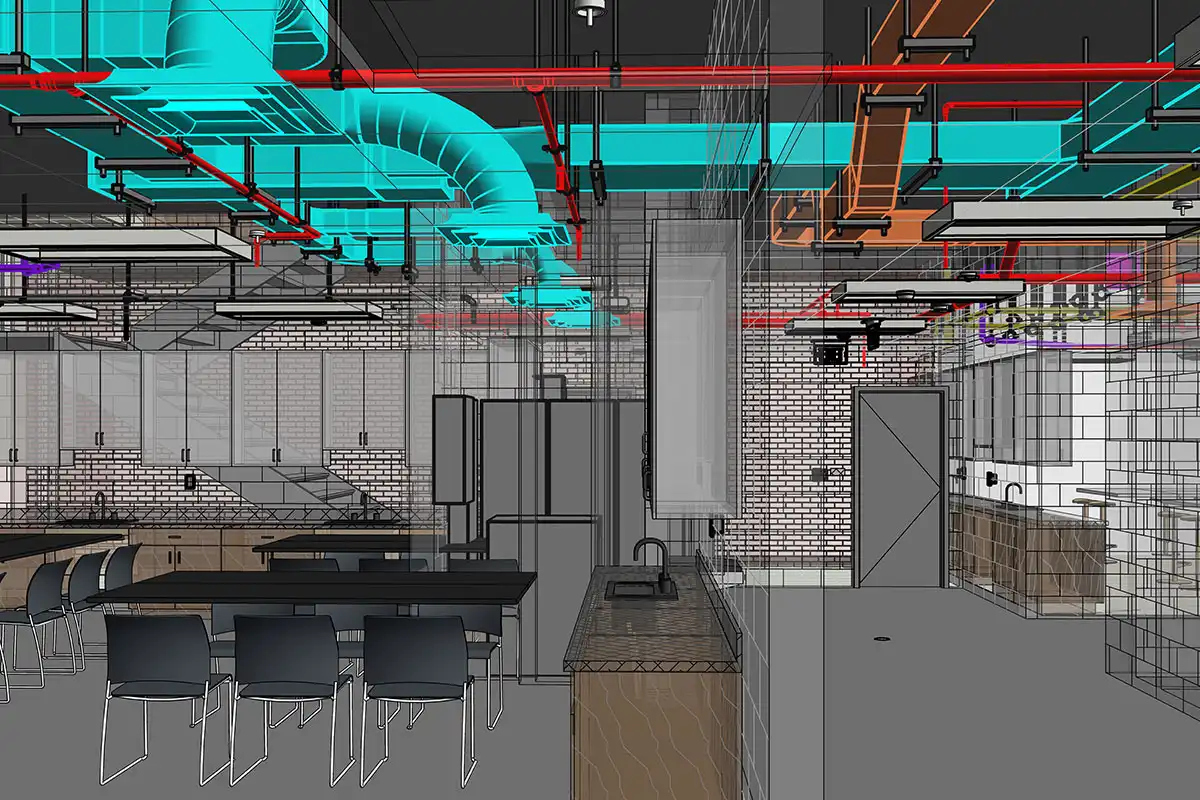
- LOD 350: Collaboration intensifies, detailing interfaces with other systems (e.g., a wall meeting a duct) for clash detection.
- LOD 400: Fabrication-ready specifics, providing contractors with detailed assembly instructions.
- LOD 500: The as-built model, complete with operational data for facility management.
.webp)
LOD isn’t about aesthetics alone; it’s about reliability—what can you count on at each stage? It’s the difference between a vague outline and a contractor’s gospel.
.webp)
Why LOD Matters: Bridging Vision and Execution
In an industry where missteps can balloon budgets or stall timelines, LOD is a lifeline. It aligns expectations, ensuring a model’s maturity matches its purpose. A designer won’t waste effort detailing a concept to LOD 400, nor will a fabricator flounder with an LOD 100 shell. This precision fosters collaboration, cuts rework, and drives efficiency. For a project like the Burj Al Arab, LOD 100 might test its sail-like silhouette, LOD 300 would lock in its structural frame, and LOD 400 would perfect its cladding—each step a calculated leap forward.
LOD in Practice: Stories from the Field
Let’s explore two hypothetical yet realistic scenarios.
Example 1: A Mixed-Use Tower in Seattle
Picture a 50-story tower blending offices and homes. LOD 100 shapes a massing model to test zoning and sunlight, pitching to stakeholders. LOD 200 adds rough floor plates and MEP outlines, pegging costs at $200 million. LOD 300 defines curtain walls and ducts for construction drawings, while LOD 350 resolves clashes—like a pipe dodging a beam. LOD 400 delivers shop drawings for façade fins, and LOD 500 hands over a digital twin tracking energy use. LOD keeps the project on rails.
Example 2: A Heritage School Renovation in Edinburgh
Now envision a Victorian school turned community hub. LOD 100 maps its footprint with 3D scans. LOD 200 sketches new interiors—classrooms and a café. LOD 300 refines timber repairs and plumbing to heritage standards. LOD 350 integrates lighting with stonework, LOD 400 details custom windows, and LOD 500 logs maintenance data. LOD preserves legacy while enabling progress.
.webp)
Tools of the Trade: Powering LOD in AEC
LOD relies on a suite of tools that bring BIM to life:
- Autodesk Revit: A BIM powerhouse, Revit spans LOD 100 concepts to LOD 400 families, driving Seattle’s tower from start to finish.
- Navisworks: This software Excels at LOD 350 coordination and catching clashes early—like a structural lifeline.
- Tekla Structures: LOD 400 precision for steel and concrete, shaping the tower’s bones.
- Rhino.Inside Revit: Marries Rhino’s freeform modeling with Revit’s rigor, perfect for Edinburgh’s ornate details.
- Bentley Systems (OpenBuildings): Supports LOD across scales, blending design and infrastructure.
- Bluebeam Revu: Streamlines LOD 300 documentation with collaborative PDFs. Pair these with laser scanning (e.g., Leica RTC360), and LOD becomes a tangible force, from vision to reality.
Challenges and Evolution: LOD’s Next Chapter
LOD has its imperfections. Its structured levels can feel restrictive for smaller firms operating on limited budgets, and misunderstandings, such as delivering an LOD 200 model when LOD 300 is expected, often lead to friction. Flexible standards like ISO 19650 offer a remedy by tailoring LOD to specific project needs. Looking ahead, the potential for evolution is striking. Artificial intelligence could soon predict LOD requirements with precision, digital twins at LOD 500 might integrate live data for real-time insights, and sustainability metrics, such as carbon tracking at each level, could expand LOD’s role in greener design. These advancements promise to elevate LOD’s impact, but their success depends on a workforce equipped to implement them effectively.
PAACADEMY: Empowering LOD Mastery
As LOD’s future unfolds, education becomes the cornerstone for turning its possibilities into practice. Institutions like PAACADEMY play a vital role in preparing AEC professionals for this landscape, offering workshops that deepen expertise in BIM and related tools. Courses such as BIM Rhino.Inside for Advanced Modular Design explore parametric workflows, blending Rhino’s flexibility with Revit’s structure to tackle complex modular systems. Similarly, Revit Flow 1.0 lays a foundation in Revit-based BIM modeling, while Revit Flow 2.0 and Revit Flow 3.0 with Rhino.Inside advance into sophisticated design techniques, including intricate façade development. Though not exclusively focused on LOD, these programs sharpen the skills—parametric design, coordination, and modeling precision—that empower professionals to apply LOD effectively across its levels.
Conclusion: LOD as a Legacy of Precision
From Seattle’s soaring towers to Edinburgh’s historic streets, LOD in BIM drives a subtle yet profound shift, harmonizing creativity with accuracy. It underpins tools like Revit and Tekla, and its potential is amplified by educators like PAACADEMY, who equip practitioners for tomorrow’s challenges. More than just a framework, LOD represents a legacy of precision, guiding the AEC industry toward smarter, more cohesive ways of building in an ever-complex world.

.jpg&w=3840&q=75)